


AI in Monitoring, Evaluation and Learning
A hands-on bootcamp day for Young and Emerging Evaluators: design a complete evaluation, build real data-collection tools, and learn to supervise AI instead of trusting it blindly.
Jakarta, Indonesia
3–4 October 2026
28 participants
18 YEEs + 10 government officials
About this workshop
Part of the RECAP-ID Evaluation Bootcamp
RECAP-ID (Regenerative Evaluation Capacity for Indonesian YEEs) is a two-day, in-person bootcamp organized by EvalYouth Indonesia for 28 competitively selected participants: 18 Young and Emerging Evaluators and 10 young government officials. Day 1 builds evaluation foundations and causal thinking. Day 2, designed and delivered by The Development CAFE, is where methodology meets AI.
Builds on Day 1
No session starts from a blank page. Teams work on their own causal pathway maps and Theories of Change throughout the day.
One deliverable, assembled all day
The Evaluation Design Suite grows section by section, so there is no end-of-day scramble.
AI is always red-teamed
No AI output enters the Design Suite until the team has documented what it corrected. This habit is the most practical skill of the day.
Both audiences served
YEEs practice designing and defending evaluations; government officials practice commissioning and quality-assuring them, and the two groups rehearse that exchange with each other.
Ready to Boost your Evaluation Journey?

What you live with
Practical skills, not tool demos
Every skill below is practiced on your own team's evaluation design, with structured prompts from the participant pack and facilitators at every table.
Prompt engineering for evaluation
Role, context, task, constraints and format: a repeatable prompt structure applied to evaluation matrices, KEQs and analysis plans, in Bahasa Indonesia and English.
Forms from prompts with Google Apps Script
Turn your evaluation matrix into a working Google Form by prompting AI to write Apps Script code, then run, test and fix it yourself. No prior coding required.
Small language models, big context
When a compact, locally run model beats a giant one: respondent privacy, offline field settings, cost, and honest limits on Bahasa Indonesia and regional-language performance.
The FRAME methodology
DevCAFE's approach to responsible AI in MEL: an ethics checklist you complete for your own design before any hands-on lab begins.
AI-assisted qualitative analysis
Support transcript coding, theme synthesis and triangulation on a real anonymized Bahasa Indonesia dataset, checked against a human-coded gold standard.
Red-teaming AI output
Three questions before anything enters your Design Suite: What did it get wrong about our context? What did it invent? What is missing?
Evaluation Methodology & AI
The Full-Day Agenda
Designed and delivered by DevCAFE · Jakarta, October 2026 · 28 participants. Lecture segments are kept short; every session produces a section of the final deliverable, the Complete Evaluation Design Suite. Tap any session to expand it.
Registration, coffee and an opportunity to explore the Design Suite Gallery.
Recap of Day 1 and framing for Day 2: turning the Theory of Change into a complete and defensible evaluation design.
Choosing evaluation methods that directly answer the key evaluation questions and fit the causal logic of the intervention.
Mapping data sources and making practical sampling decisions that reflect real-world constraints.
Refuel. The labs are next.
Responsible use of AI in monitoring, evaluation and learning, including the FRAME methodology and the role of small language models.
Hands-on prompt engineering for evaluation design using role, context, task, constraints and format.
- Apply a repeatable prompt structure to evaluation matrices, KEQs and analysis plans.
- Work in Bahasa Indonesia and English.
Lunch is provided. Prayer space is available.
Turn an evaluation matrix into a working Google Form by prompting AI to write Apps Script code, then run, test and fix it.
- No coding background is needed.
- The focus is on specifying precisely and verifying carefully.
Working with an anonymized Bahasa Indonesia interview dataset, teams use AI to support transcript coding, theme synthesis and triangulation with quantitative results.
- Compare AI-generated codes against a human-coded gold standard.
- Explore where AI over-generalizes or misses nuance.
- Draft analysis and reporting outputs while preserving the evaluator's own voice and judgment.
Last stretch ahead.
Parallel track sessions allowing participants to explore different topics and applications.
Complete the Evaluation Design Suite and conduct a structured peer review with another team.
Participants reflect on what they have learned and how they can apply and share the approach in their own work.
Closing reflections, certificates, mentoring pathway and next steps for participants.
The red-team rule, all day long
No AI output enters the Design Suite until the team has documented what it corrected. Three questions, every time: What did it get wrong about our context? What did it invent? What is missing? By the end of the day this is a reflex, not a rule.
Participants bring
A laptop, the printed Day 1 outputs of their team, and a program or policy from their own work to draw on in exercises.
DevCAFE provides
Participant packs (Design Suite template, structured prompt library in Bahasa Indonesia and English, Apps Script prompt templates, FRAME checklist, peer-review rubric, train-the-trainer mini kit), the anonymized Bahasa Indonesia practice dataset, and AI tool access for all participants for the day.
Room setup
Seven tables of four, mixed so that each table includes at least one government official where possible; wall space for the morning gallery; reliable Wi-Fi with an offline fallback pack prepared for the labs.
Language & accessibility
Sessions delivered in Bahasa Indonesia with materials in Bahasa Indonesia and English. Two DevCAFE lead facilitators plus table mentors; one facilitator holds timekeeping strictly, as the day is deliberately full.
This agenda is a working draft for discussion with EvalYouth Indonesia and can be adjusted to the final venue, participant profile and timing preferences.
Our stance on AI
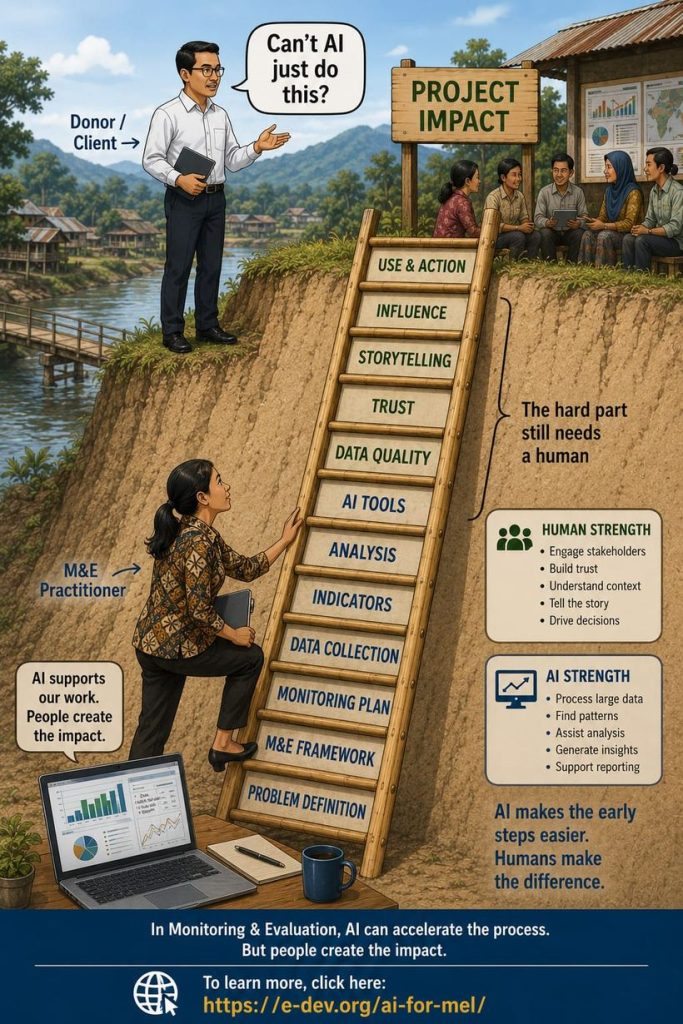
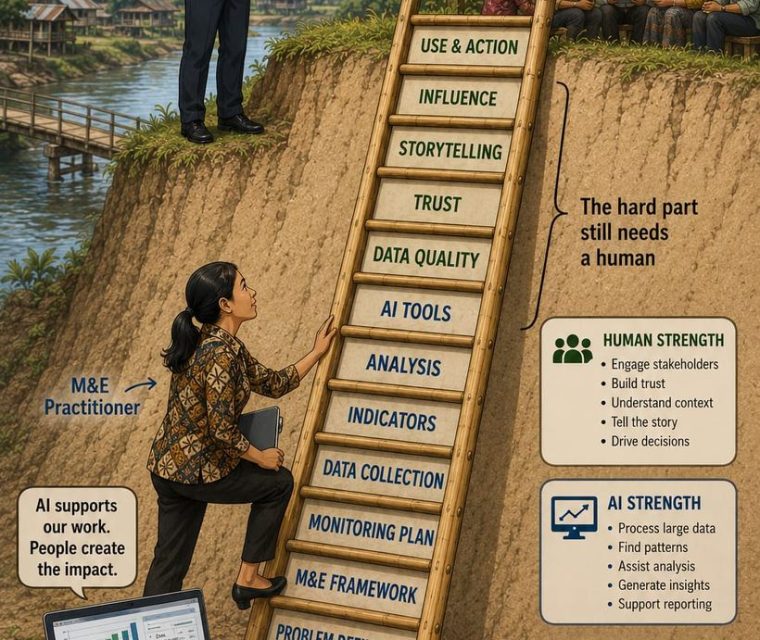
AI accelerates the process. People create the impact.
This day is not about replacing evaluators. It is about making the early steps faster so that the hard part, the part that still needs a human, gets more of your time.
"AI makes the early steps easier. Humans make the difference."
Engaging stakeholders, building trust, understanding context, telling the story and driving decisions stay with the evaluator.
"Can't AI just do this?"
The question every commissioner will ask you. Day 2 gives you a practiced, honest answer: here is what we delegated, here is what we verified, here is what we refused.
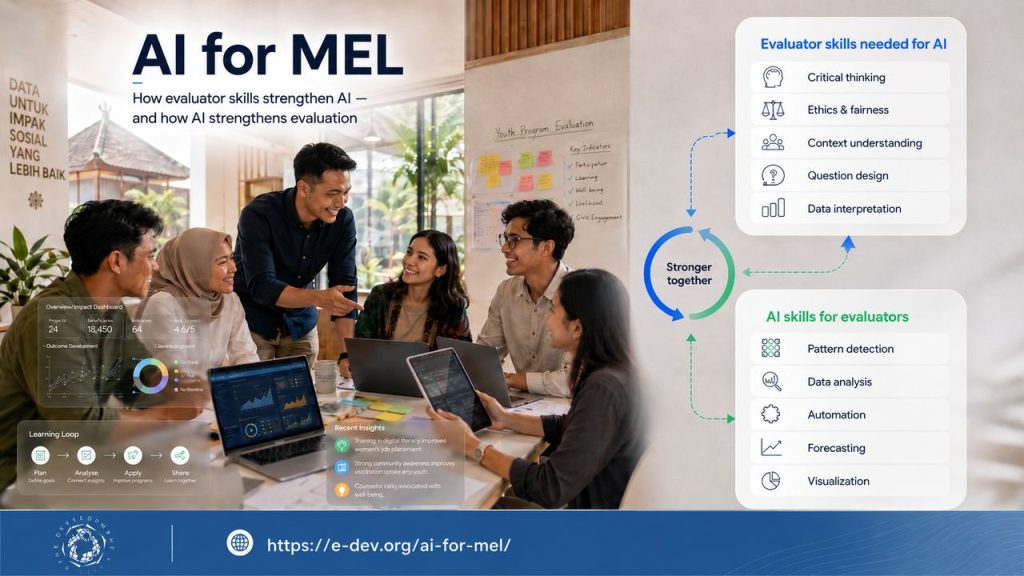
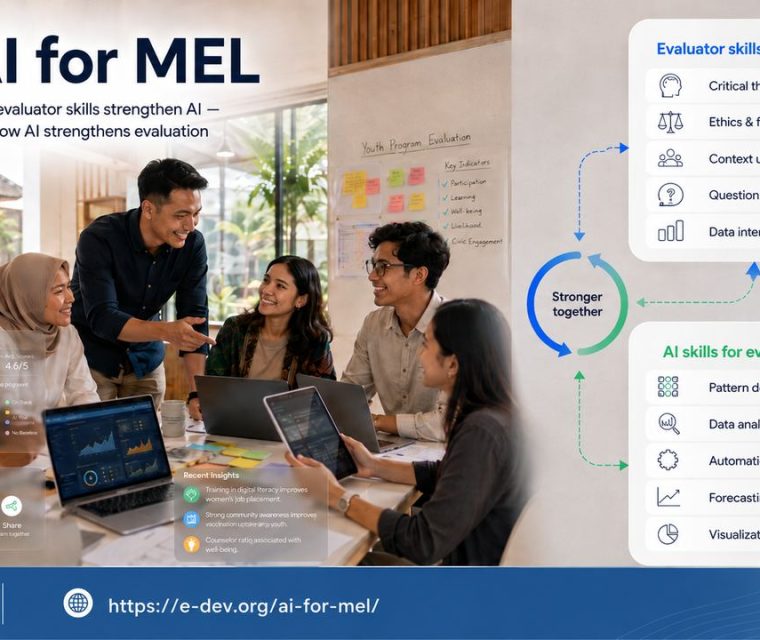
E-Dev's AI for MEL course explores how evaluator skills strengthen AI and how AI strengthens evaluation: critical thinking, ethics and fairness, context understanding, question design and data interpretation on the human side; pattern detection, data analysis, automation, forecasting and visualization on the AI side. Stronger together.
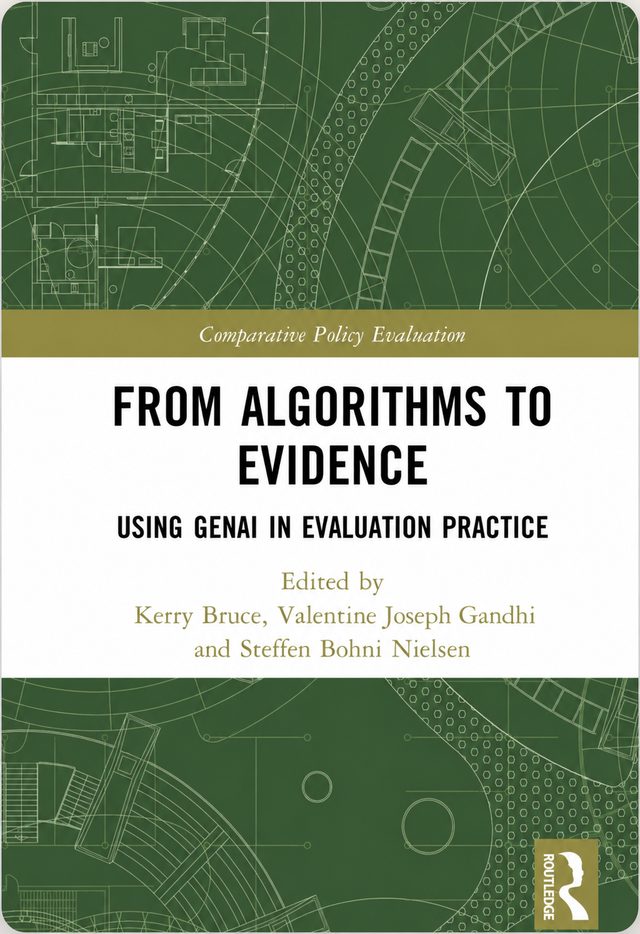
Forthcoming from Routledge
Edited by Kerry Bruce, Valentine Joseph Gandhi and Steffen Bohni Nielsen · Comparative Policy Evaluation series
The thinking behind this bootcamp day runs deeper than one agenda. This forthcoming edited volume examines how generative AI is actually being used in evaluation practice, co-edited by DevCAFE's founder. Participants will recognize the same commitments on Day 2: supervised use, honest limits, and evidence over hype.
From the series & the DevCAFE ecosystem
Past workshops and further learning
The Innovations in Evaluation Workshop Series sits inside a wider body of DevCAFE and E-Dev work on methods, technology and learning systems.
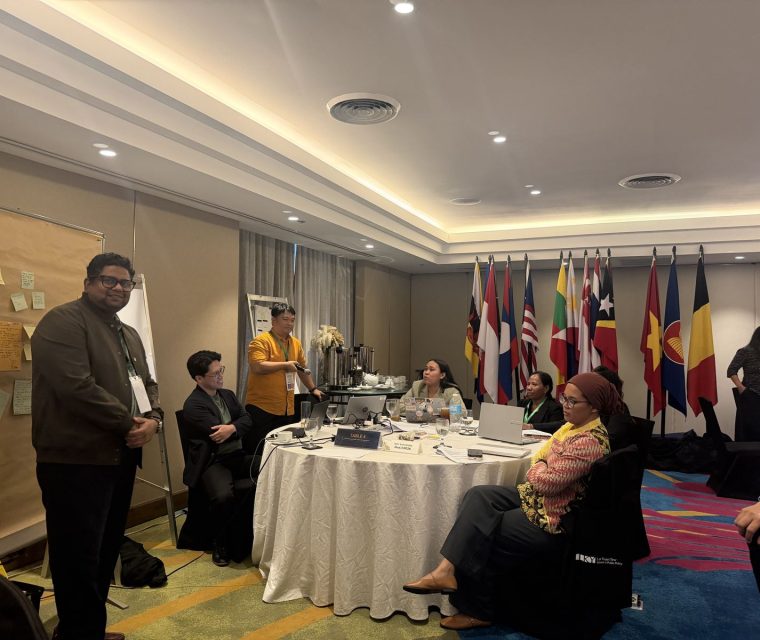
Past Workshop
An earlier session in the Innovations in Evaluation Workshop Series on E-Dev.
Past Workshop
An earlier session in the Innovations in Evaluation Workshop Series on E-Dev.
DEVCAFE Article
Technology as development innovation, from the DevCAFE main site.
Practitioner Toolkit
Twelve working modules for designing and running monitoring, evaluation and learning systems: from the first scope of work to the last dashboard. Method by method, with the donor guidance each one answers to, and every source linked.